First proper review of How I Learned to Sing was spotted yesterday, in The Crack magazine, North East England's longest-running listings and culture magazine. You can read it in full here on their rather nifty website. Here's some (most) of it...
'And what a fabulous collection it is, an unpretentious examination of art and life in general with his role at the Arts Council naturally informing his worldview (“I could be sticking words to beats somewhere near Boyana / Instead of playing jargon bingo eating a banana”). Clear-eyed and rooted in reality (he’s not afraid to reference Sky Sports, The Lion King and Kafka) and with a finely honed sense of social justice and sparky wit this is a collection that is rich with biographical detail. And he gives just as much weight to the little moments in life, which speak just as loudly as the big stuff.'
I'm pleased with that, though a bit puzzled by the Lion King thing, as I don't recall deliberately making one. I did watch the video a lot when the kids were little though so maybe it snook in somehow. Anyway, hakuna matata.
And I'm pleased it doesn't say 'autobiographical detail' too.
Friday, 2 August 2013

Sunday, 23 June 2013
Heads Up
The film above was made recently by Sarah Pickthall and Abbie Norris as part of a series called Heads Up as part of Arts Council England's Creative Case for Diversity. It features a few bits of my poetry, and some extracts from a performance of poems from The Dunno Elegies sequence in How I Learned to Sing.
Colin Hambrook, editor of www.disabilityartsonline.org.uk wrote a blog about the film which interestingly (for me at least) very much picks up on the connections between my poems and the other ideas in the film. Never has so much connection between my work and William Blake been made! But, seriously, as I thought about it, I realise Colin is spot in saying ‘For Robinson adapting to the world as it happens is a process of looking for the bigger picture in the detail’, and not just in my poetry but throughout my ‘thinking practice.’
I was pleased that the diversity of my own practice was built into their vision – including my poetry practice. (Thanks to Arc for letting us film a performance in their studio, by the way.) The bridges of Stockton come out of it well, as does the industrial imagery of Teesside, and there’s even a walk-on part for our cat, playing herself. Those who stay to the end will notice the soundtrack is music I made myself (not for this specifically, but for the poetry performance you see a glimpse of), and I will admit to being very pleased how that sounds.
Wednesday, 5 June 2013
Ready to sing: book launches (after short nightmare)
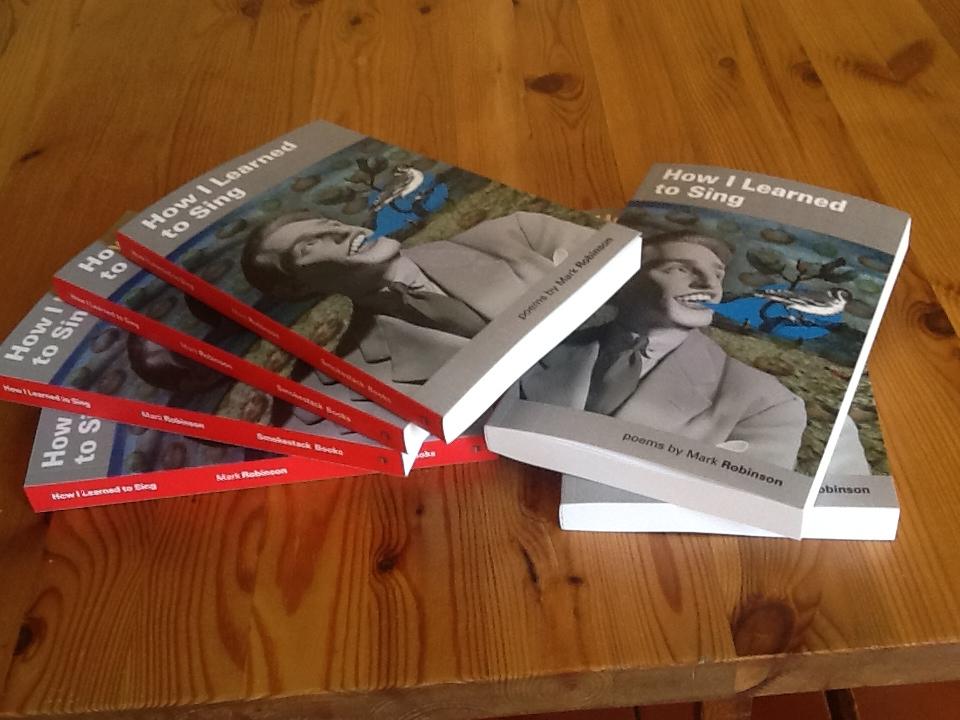
Smokestack Books (which sounds like a small corporation but is in actual fact the poet Andy Croft) were expecting delivery of the books, I was excited to pick them up. Then they didn't arrive. Never mind, they'll be there Tuesday, after the Bank Holiday, we thought.
But they weren't. Phone calls revealed the printer was about to go into administration and nothing could be despatched, even though paid for, until that was clear, if at all. The company has now, sadly, ceased trading, with a warehouse full of books. Smokestack had 2 titles in the warehouse waiting to be sent out - my own and Gerda Stevenson's If This Were Real. Andy expects to get these, eventually, but we have had to retrieve a few copies which had got out - 1 box sent to the bookshop distributor, though most had already gone to bookshops to fulfil orders - and get a short emergency print run done to cover the launch period. This has meant a lot of brain stress and extra expense for Smokestack. (Not currently receiving any funding by the way.)
Anyway, I have now held copies in my hand, and can safely remind about/alert you to a couple of events next week to launch this book - Monday 10 June, 7pm at the Green Room in the Green Dragon Studios in Stockton, and Wednesday 12 June, 6pm at the Lit and Phil Library in Newcastle. (More details here.)
If any of you are in the area, it'd be great to see you. Both events are free, though do email the Lit and Phil to confirm a place. If not, why not do yourself and Smokestack a favour by buying a copy direct from their website, or another of their very fine titles. (One is by Superman's dad. Well, Christopher Reeves' dad anyway.)
You can also listen to me read some of the poems in a couple of downloadable podcasts I've done, which can be found here.(There are more to follow, too.)
Tuesday, 4 June 2013
A Reader's Life
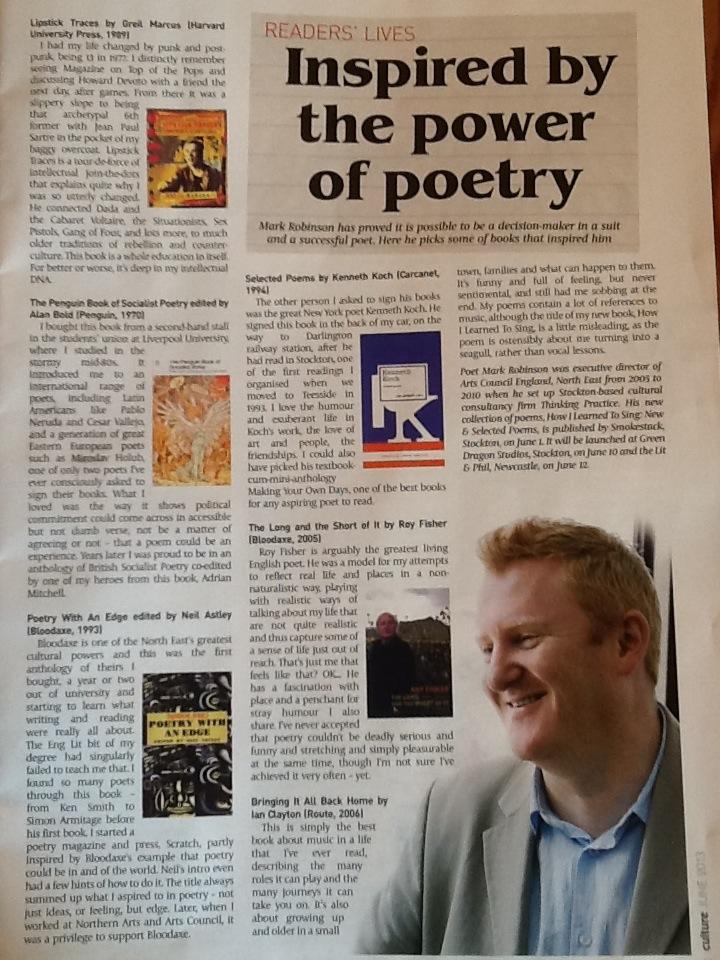
I recently agreed to write a ‘Readers Lives’ column for the Journal’s Culture magazine. This is a kind of literary equivalent of Desert Island Discs – 6 books that have been important to you in your life. Sounds like fun, I thought…
Then it all went a bit like that part in Nick Hornby’s High Fidelity where Rob can’t decide on his favourite songs. I decided to rule out novels, to make it a bit easier. I toyed with the idea of restricting choices to poetry. Then I thought be a bit broader than that but would also rule out non-fiction expect to do with music and the arts. I spent an age looking at my book shelves. Then another 2 ages writing a long list and then a short list. Then I decided to write it very quickly and forget about it. Then I took out '10 years in an open necked shirt' by John Cooper Clarke and put ‘Lipstick Traces’ in and pressed send before I could change my mind.
Those of you lucky enough to live in North East England can pick up a copy of the Culture magazine in many arts venues, cafes, pubs and other cultural spaces. Those of you not so fortunate continue reading, or click here and proceed to page 11 to find out which 6 books I went for in the end, or click on the picture above for a larger version. I do recommend reading the whole issue though – lots of coverage for Festival of the North East.
What I wrote:
Lipstick Traces by Greil Marcus
I had my life changed by punk and post-punk, being 13 in 1977. (I distinctly remember seeing Magazine on Top of the Pops and discussing Howard Devoto with a friend the next day, after Games. From there it was a slippery slope to being that archetypal 6th former with Jean Paul Sartre in the pocket of my baggy overcoat. Lipstick Traces is a tour-de-force of intellectual join-the-dots that explains quite why I was so utterly changed. He connected DaDa and the Cabaret Voltaire, the Situationists, Sex Pistols, Gang of Four, and lots more, to much older traditions of rebellion and counter-culture. This book is a whole education in itself. For better or worse, it’s deep in my intellectual DNA.
The Penguin Book of Socialist Poetry edited by Alan Bold (Penguin)
I bought this book from a second-hand stall in the Student Union at Liverpool University, where I studied in the stormy mid 80s. It introduced me to an international range of poets including Latin Americans like Pablo Neruda and Cesar Vallejo, and a generation of great Eastern European poets such as Miroslav Holub, one of only two poets I’ve ever consciously asked to sign their books. What I loved was the way it shows political commitment could come across in accessible but not dumb verse, not be a matter of agreeing or not – that a poem could be an experience. Years later I was proud to be in an anthology of British Socialist Poetry co-edited by one of my heroes from this book, Adrian Mitchell.
Poetry With An Edge edited by Neil Astley (Bloodaxe)
Bloodaxe is one of the North East’s greatest cultural powers, and this was the first anthology of theirs I bought, a year or two out of University and starting to learn what writing and reading were really all about. (The Eng.Lit bit of my degree had singularly failed to teach me that.) I found so many poets through this book – from Ken Smith to Simon Armitage before his first book. I started a poetry magazine and press, Scratch, partly inspired by Bloodaxe’s example that poetry could be in and of the world. Neil’s intro even had a few hints of how to do it. The title always summed up what I aspired to in poetry – not just ideas, or feeling, but edge. Later, when I worked at Northern Arts and Arts Council, it was a privilege to support Bloodaxe.
Selected Poems – Kenneth Koch (Carcanet)
The other person I asked to sign his books was the great New York poet Kenneth Koch. He signed this book in the back of my car, on the way to Darlington railway station, after he had read in Stockton, one of the first readings I organised when we moved to Teesside in 1993. I love the humour and exuberant life in Koch’s work, the love of art and people, the friendships. I could also have picked his textbook-cum-mini-anthology Making Your Own Days, one of the best books for any aspiring poet to read.
The Long and the Short of It by Roy Fisher (Bloodaxe)
Roy Fisher is arguably the greatest living English poet. He was a model for my attempts to reflect real life and places in a non-naturalistic way, playing with realistic ways of talking about my life that are not quite realistic and thus capture some of a sense of life just out of reach. (That’s just me that feels like that? Ok...) He has a fascination with place and a penchant for stray humour I also share. I’ve never accepted that poetry couldn’t be deadly serious and funny and stretching and simply pleasurable at the same time, though I’m not sure I’ve achieved it very often – yet.
Bringing It All Back Home by Ian Clayton (Route)
This is simply the best book about music in a life that I’ve ever read, describing the many roles it can play and the many journeys it can take you on. It’s also about growing up and older in a small town, families and what can happen to them. It’s funny and full of feeling but never sentimental, and still had me sobbing at the end. My poems contain a lot of references to music, although the title of my new book, How I Learned To Sing, is a little misleading, as the poem is ostensibly about me turning into a seagull, rather than vocal lessons.
Friday, 24 May 2013
The sound of my own voice

The amount of times you read poems in the course of getting a book ready for publication is underestimated in the public imagination. You think you have finished writing them, having worked on them for anything between, oh, 20 minutes and 15 years, and edited, revised, sorted, revised a multitude of times, and then you have to proof read the book.
Now, I am a self-confessed terrible prof-roader. When I published the last issue of Scratch, the magazine I edited between 1989 and 1997, I put the name as SCARTCH on the cover as a deliberate homage/penance to all the fine writers that had suffered at my hands/eyes. (Matthew Sweeney told me he thought it was probably a better name, and he was probably right.) I put it down to being a Grauniad reader for too long.
Of course, even proof-reading throws up further corrections and amendments. We also had to decide how to handle the poems with longer lines - indents, shortening the lines even, bigger pages. (Smokestack's format is relatively small, which I rather like as it makes the pocket-sized, in comparision with my last publisher Flambard, who went for larger than normal which meant line-length wasn't an issue.) In the end we went for a combination of indents, 'stepping' one poem a la WC Williams, and one or two tight margins. That seemed to draw less attention than an unusually shaped book, as I don;t consider myself a 'long-lined poet', like CK Williams for instance.
After all that proof-reading I needed a break from these poems, but have just spent some time recording some for some 'podcast'-style 15-20 minute readings you can listen to or download here. This means listening to me reading them a lot, in the edit. So I am a little tired of the sound of my own voice right now. But hopefully you won't be.
You can find the first podcast - poems from the title sequence of How I Learned To Sing here. or just go to the new podcast page of the site. More to come.
By the way, you can now order the book direct from Smokestack - they pay all their taxes so far a I know, and if they offshore anything it'll probably be in Greece or Albania or somewhere that needs the help. (That was a joke if HMRC are reading.) It'll be ready any day now - which is very exciting.
Sunday, 14 April 2013
How the hell could an onion smell of a political doctrine?

Unsure about adding to the flow of words about Mrs Thatcher, I thought I'd share two unpublished poems from the upcoming book that connect to her and her ideas. The first is from a sequence called The Dunno Elegies that considers (if that's something poems can do, I hope it is) various sites around the North East and their transformations, regenerations and degradations, using the recurrent image of angels for the spirits that once walked and worked in those places. It is partly an extended pun on Rilke's Duino Elegies.
This poem references the place where Thatcher did her famous 'walk in the wilderness', perhaps the closest she came, briefly, to thinking desolation might not be a viable way of carrying on. It also draws on memories of visiting the offices of Tees Valley Regeneration, on that very land, surrounded by call centres and colleges. Is it a place or a community, beyond being a site? That we even need to ask the question is part of Thatcher's damaging legacy.
The 2nd poem takes a more tangential and playful approach.
Dunno Elegy 2
Teesdale,
Thornaby
To walk this wilderness you must commit
to the past, to taking of evidence
from the future. You must stand prepared
to stare down demons that draw strength from dirt,
the difficult to leave behind dirt.
Head Wrightson spilt blood here, ran it off
into the river and called it rust, or money.
These call centres exist. But they are blank
as acetates laid over a map in a museum,
blank as minds of reluctant students.
Bombs could fall and no adrenalin would flow.
George Stephenson’s ghost stalks the corridors,
pulled in all directions by fear of kidnap.
Stockton chains him in, Darlington too and
the wrong side of the tracks by the Tyne.
He watches over business studies degrees
and daydreams of Timothy Hackworth
bashing metal up country, near enough forgotten.
They made things here. The she-devil walked here
clutching her handbag and nearly said sorry.
Suicides the Durham bank of the river
brought more than those souls washed up in
Yorkshire.
Becoming angels left their heads bloated.
The streets are dotted with students hunting a pub.
The revolution will not be televised.
There is no song to this place, no rhythm,
it is all straight lines and ambient backwash.
Every call has an answer, an even tone
blanketing all the noise that once was here.
Recycled air turns solid after twelve hours
with hardly a calorie burnt away.
The beaters and welders and handtool-burners
gather by the river to fish and to watch.
They talk of bait and boredom, of long years
watching, of the buildings and the quiet
drawn like curtains over the banging they hear.
Sparks flew but a spark now would stand out,
bright on the soft stone and white wash.
This place is all curves and circles, not sparks.
When this circle reaches back to its beginning,
you can feel the bombs drop. The weights
were heavy they used to move things here.
In the offices of Tees Valley Regeneration
a model appeals to the unseen gods.
It is an idea of heaven gone mad. It is innocent
boxes and balls that nothing can balance.
The angelic welders walk around us.
They are not concerned at our planning,
give permission for nothing, just spit
on the polished floors, breathless
from their sweated effort regardless.
They make no announcements about scale,
or what shape it should be, no prototypes
or macquettes can be put under glass
to start conversations in reception.
They do not know any of the answers.
They are not waiting to be shown through.
We are left with the questions, smooth
and unrewarding to the touch as iron.
There is no give here, nothing but
resistance to be found even now.
Everything is a trap for these angels.
Documentary
I
knew what would happen next.
I
walked out backwards into the yard.
There
was a huge onion on the step.
It
smelt of acrid string and Thatcherism.
I
burst into tears and sobbed uncontrollably.
If
you’d have asked me why, I’d have said nothing.
I
was incoherent and uncomplaining.
How
the hell could an onion smell of a political doctrine?
On
estates to the north of Stockton they would tell you.
They
would open the shutters slightly.
They
would put out a fist to meet your nose.
They
would explain that there is little difference.
They
were used to finding onions on their doorsteps.
I
was not, I was downright puzzled into anger by it.
I’d
have turned round and wormed my way back in again.
But
words cannot be unspoken.
Besides,
there was now a chicken on my doorstep.
Tuesday, 19 February 2013
Advance Information

It's a weird and unsettling thing seeing yourself described by others to others, in a way that hopefully makes them a little bit more interested in stocking your book. That's what an Advanced Information Sheet does. You can see mine here.
I am used to describing what I do and who I am in multiple ways to multiple people. That means using different kinds of language, which I'm fine with, and finding the truth in all of them. It would be possible to feel 'inauthentic' in describing my consultancy or coaching offer, just as it would in creating interest in booksellers, but I have so far avoided feeling that. The biographical notes I use for my Thinking Practice work, and how I describe myself as a poet, or simply to someone new I meet, are consistent, although not necessarily in the details they choose. Some feel more natural than others, none feel wrong.
Finding that unity, and exploring the plurality and instability within it, is one of the themes that runs through How I Learned To Sing, particularly the title sequence, but it is also there in the older poems. So I was interested to read the Advanced Information Sheet for How I Learned to Sing, and see what it focussed on. I had helped Andy Croft, my publisher at Smokestack, with the blurb, but from then it was very much up to Andy and the people at Inpress to develop it - they after all know how to get things into shops. (Even when I used to published poetry through Scratch, that wasn't something we majored on.)
This was a little similar to the feeling I had when someone pointed out that LinkedIn endorsements - those weird, rather pointless-seeming traffic-generators introduced recently - gave a sense of how you are seen. I am, apparently, arts admin and fundraising guy, which is not really how I would describe myself at all. (I administer myself fine, but that's where the 'offer' stops, and I try and avoid fundraising and rightly so given my recent track-record.)
So this AI sheet says - he used to be big in the Arts Council so might have some profile there, he's from the North East and good enough to get in the same anthology as people from there you've actually heard of (which we also supply), and some of the poems can be seen in the context of cultural transformation, that thing you read was under threat recently. (I've always wanted to be of 'current affairs interest', so that's a plus.)
Does this feel like anything to do with the poems, to me? Well, in the first instance, not really, although I recognise there are lots (relatively!) of people who know me through my arts work. It feels increasingly distant, but I know why it's a hook, and it does explain why I've not published a book for such a long time. The second bullet point is by the by, much as I admire those writers, but I guess is a kind of 'benchmarking'. If I'd ever won a prize I guess that would go there, but hey ho. And thirdly, yes, that is very much part of the book, in The Dunno Elegies particularly, but also in other poems. The poems from Bringing Down The Government, from Half A Mind, and Gaps Between Hills describe the same places in different ways too.
I'll be using this blog to unpack some of the themes of the book - and to promote it, to be honest - and the processes that have gone with it, and to share some of the poems. So consider this Advance Information.
Subscribe to:
Posts (Atom)