Thursday, 3 September 2015

Just being here is glorious: two thoughts on refuge


Where do I go from here? from Geoff Broadway on Vimeo.

I've found the news and the reactions to it has been making me mute recently. Not unreactingly mute, but wanting, needing, to add silence more than sound, at least in public. (I am 50% introvert, 50% extrovert, but much of the energy of the outside world is decidedly unappealing right now.)

I've been thinking about two things today though, which I feel like sharing. One is a work by the artist Geoff Broadway, made when he was Artist-in-Residence at Durham Cathedral in 2001, called Where Do I Go From Here? It was a really powerful piece which you can see on Geoff's website or above. I wrote an essay for the brochure at the time - which I can't find right now, although I did find an extract online, which I'll share here, to give you a flavour of Geoff's work and my response to it. The issues are those we face today. They are not purely contemporary issues. David Cameron is to  blame only for his own feebleness and lack of compassion. The problem goes much further. Anywhere, here are a few words from 2001.

Two sample headlines from the front pages of the Daily Express during the last few days: 'ASYLUM: WE ARE BEING INVADED', and 'REFUGEES: FLEE FOR YOUR LIVES'. I didn't read any further...

...Far from creating art in a protected cloister at Durham Cathedral, Geoff Broadway has found himself reinventing the residency as something if not on the front line, then at least somewhere in the war zone, with himself a kind of the war artist or reporter gathering and manipulating stories and
images. Stemming from his discovery of a 12th Century Knocker which could be used to request sanctuary for up to 40 days, (no one was refused, all had to give up their own clothes and stay within rooms at the Cathedral) he has looked outwards from the Durham Peninsula at one of the most pressing changes in local life since the closure of the pits: the dispersal to the North East of a growing number of asylum seekers and refugees from some of the many troubled parts of the world: Kurdistan, Afghanistan, Sudan, Iraq, Zimbabwe, Bosnia, Croatia. The week after an Iraqi Kurd had been murdered in Glasgow, and after reading those headlines, listening to a rough cut of the voices heard in this exhibition was a sobering, humbling and uncomfortable experience. I suspect it will be likewise for those visiting this exhibition...

...These are people whose land has been taken from them, and who are expressing themselves in a foreign tongue. Their comments thus become fascinatingly paradoxical: at once naïve in their expression, and thus 'sincere', the haltingness of the English adding extra layers of poignancy (perhaps unwanted layers), but also artificial and constructed in a way mother-tongue testimony might not be. Although the individuals here speak passionately, bitterness is only apparent in one or two: those whose English is most impressive. It is as if the control of language allows for this expression, this emotion; as if a more rudimentary facility somehow keeps those negative emotions in check, or merely from being expressed or heard. Of course, much of the testimony betrays the wordless fear and loss that night and silence bring. Broadway's installation, poised on the cusp of dark and light, silence and confession or testimony, is an eloquent evocation of the hope and despair implicit in the double-edged concept of refuge...

. ...This is a highly wrought piece of work, despite the rawness of the tales which can be heard. It is concerned with the creation of beauty, with, therefore an aesthetic of pleasure and sensuality rather than a simplistically mimetic one of dislocation and anguish. This seeming contradiction bothers Broadway, makes him uneasy about exploiting people who are now his friends, but he is ultimately not prepared, as an artist, to give up striving for harmony within the experiences shared with him. He does this by putting aside straight realism or documentary for something more exploratory, juxtaposing words and images within a contemplative setting which demands both physical and emotional commitment from the audience.


Much of our reaction to the 'problem' of asylum seekers stems from an ignorance which this work may do a little to combat. Its chances of doing that rest, I think, not on the testimony of the voices you will hear, affecting as that is, but on your willingness to kneel or crouch low enough to let stories be whispered into your ear in the dark, and to look at the sea and the sand and the sky projected upon the water, and your ability to imagine that this is both a mirror (refocus: you can see yourself, and the night sky of exile behind you) and a wishing well. This contemplation is your only place of refuge, of appeal. This is not a sensationalist work, or a liberal work appealing for special treatment, it is essentially a tool of compassion, of feeling with, made for feeling with. This is the sense in which Broadway's nervousness about his own political agenda is resolved, and what makes this a truly suitable work to emerge from a residency at Durham Cathedral. If the World Heritage Site of which the Cathedral is the centre means anything it must surely include a link back to the traditions of shelter, succour and compassion which Broadway identified in the Cathedral's Sanctuary Knocker. The North East must, whether it relishes the prospect or not, find ways in which to continue this tradition in the 21st century, rather than similarly ancient strains of ignorant intolerance."

The second thing I was thinking of was the 8th of the Dunno Elegies in How I Learned to Sing, which is 'set' on Hartington Road in Stockton, a place where many refugees, asylum seekers and other immigrants have lived in recent decades. It says anything I want to say right now.

Dunno Elegy 8 

Hartington Road, Stockton-on-Tees

‘Just being here is glorious’ Rilke

If terror is the first thing to marrow our bones
when we see these green hills filter the sky
what next? What comes after fear’s surf breaks
on the tiny pebbles of the everyday?
One foot in front of the other until
you have forgotten that you are not normal.
A letter on a doormat. A dishcloth in the sink.
Cleaning windows on the seventh floor.
Hassan from Iraq, Apollo from the Congo,
Farooq from Sri Lanka, Betty the Afghani,
Honey who would not speak or smile,
place their feet where the Roman empire trod,
the land of Hadrian and the land of angels,
to sing of our  heartening normality,
our placidness and hospitality.

Buttoning up a child’s coat in a wet playground,
toggles the shape of ducks bright against the quilt,
they sing. Listening in their yards to playtime
they sing of home and home and the spaces between.
They chat over coffee to the spirits of family
who do not understand where they have arrived,
who walk through markets confused and adrift
wondering how this light makes familiar shapes
look and feel so different, so distant.
The rain goes through them like a melody
fills the house when they sing in the evenings,
folksongs from their other home, lifting them
like high winds lift tiles to put them down
gently, in the same spot, the same pattern.

All that was solid has melted into haircuts
strange and terrible, misshapen boots,
questions to be answered. But survival
means this becomes home, a place where angels
don’t care if you are coming or going.
You walk through the same rain as angels,
perform your own ceremonies of thanks.

Tuesday, 20 January 2015

6 Degrees of Connection


At the end of 2013 I was commissioned by Tyneside Cinema to write and perform a poem as part of a conference about young people and engagement in specialised cinema. You can read about the event here.

It was a pleasing mixture of fun and terror writing a poem based on the conference as the conference happened. Since then we have developed a publication which combines a revised version of the poem, alongside prose which summarises some of the learning from Tyneside Cinema's Young Tyneside programme and the evaluation of it by Morris Hargreaves McIntyre, which can also be downloaded from the Tyneside's website here. This was published in 2014 but for some reason I did;t put this blog up then. Better late than never.

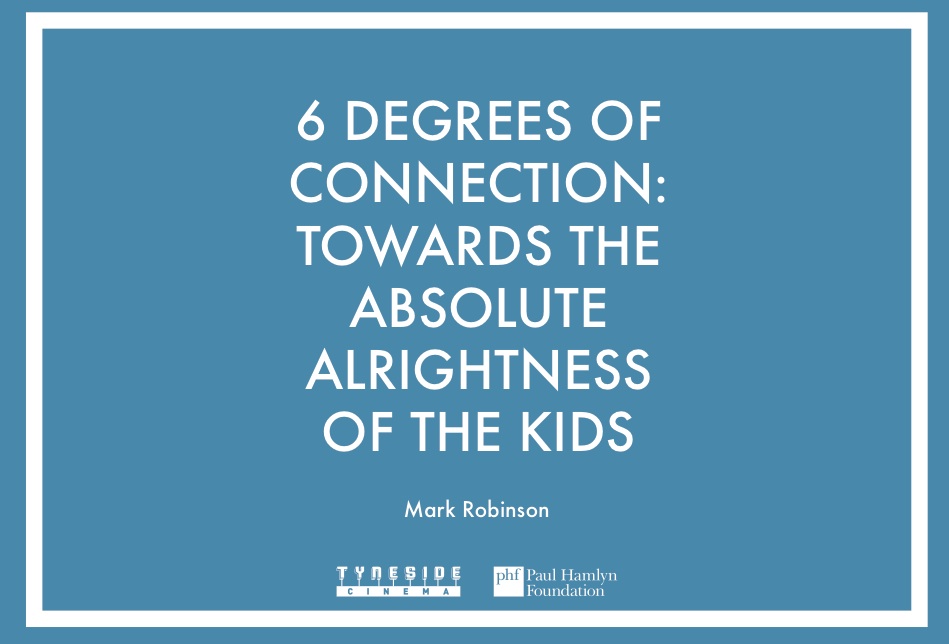
The publication, Six Degrees of Connection: Towards the Absolute Alrightness of the Kids, can be downloaded from the Tyneside's website or in the Publications section of the Thinking Practice site.
The poem got shorter after the actual event because it takes longer to write something short than something long, as anyone who's tried to write something good knows.

Video evidence of the reading of the original version exists, but I'm not telling you where. It probably goes without saying, but I am very up for being asked by others to do this sort of thing in interesting places and interesting situations.

The Infinite Town


Above is a photograph of a poem I was commissioned to write by Stockton-on-Tees Borough Council. It is inscribed in a large plinth on the High Street, part of a huge redevelopment of the town centre. From the summer, an automata in the shape of a train will arise from the point (once a day, in Trumpton-style).

The poem was one of a number I wrote in response to the commission, and was chosen by the panel overseeing the redevelopment. The poem had to do a number of things (some for the commission, some for me):

  • Be memorable but not too simplistic - some people will see this a lot and I wanted it to strike them differently over time
  • Have local relevance and reference, but not be backwards looking
  • Not be trite
  • Have a slightly 'civic' tone
  • Have a kind of density to it.
So if you know Stockton you may pick up references to the Infinity bridge, which you can just about see from the plinth, the Tees, and the town's firework tradition. (Starting with the invention of the safety match.) It was also, of course, part of the birth of railways.

I actually did't know this was in place when I first saw it, on a shopping trip just before Xmas. I think it looks rather handsome, if I may say so myself. It's also a rather odd feeling to see your name in such a permanent-looking site.

It was very kind of the Council to put a big bow on it too. I think this was just for Xmas:


Sunday, 11 May 2014

Poetry Salzburg Review review


Michael Blackburn has written a very interesting, and generous, review of How I Learned to Sing in Poetry Salzburg #25. It's part of a long essay so I've not copied it all out. There are a few choice paragraphs below, use technology to read the images if you want to see the full thing. 

I like the idea of being part of 'the airbrushed Great Poetry Surge' but should point out I presume Michael means airbrushed out… I don't think we used Photoshop to look thinner. (Might be a good idea now, though…) 

"With his influential magazine, Scratch, as well as his own poems, Mark Robinson was one of the original participants of the airbrushed Great Poetry Surge of the 1980s and 1990s (forget about the ‘New Generation’ stuff – that was the metropolitan establishment waking up to what they’d failed to see and which they’d played no part in producing). When he progressed from vegetarian chef to arts administrator, turning from metaphorical poacher to gamekeeper, he took a decade-long self-imposed sabbatical from publishing his work. For the poetry world this was a loss, but with this excellent collection from Smokestack Books we can catch up with what we missed.

‘The world is a place that has changed and I need your help’ the poet says in one of his earliest pieces, and it could be taken a primary motif of all of his work. Robinson has become a chronicler not just of his personal life – marriage, children, getting older – but also of the society in which he lives.
….
For me, the great strength of his work is the straight-forward human warmth it demonstrates… If you ant to get the best of Robinson, I do not think you can do better than ‘My Love’, which is one of the finest contemporary love poems I have read, and exactly as Milton said poetry should be, simple, sensuous and passionate – and economically short, deploying clear images and a sure sense of rhythm and pace: ‘Such a long time ago now, and nothing to be done,/ which is why I bring you fruit and drink and hope.’


As Pound wrote in Canto 81, ‘What thou lovest well remains, / the rest is dross’; and with this poet’s talent and our luck what remains is a poem like that.’ "

Sunday, 27 April 2014

Poetry cushions anyone?

When a poem is published, it's no longer yours. The downside is you often feel it has expired somewhere just round the corner. The upside is that sometimes poems take on a life of their own. Or more precisely, readers give them life beyond their published form or the rites of performance. They pass them on. They anthologise them. They do surprising things with them. They take them into their own lives.

This has happened to me a couple of times. Once, my poem ‘Buttocks’ was used in a Longman school book, in a compare and contrast exercise with a poem by Louis Macneice and ‘The Road Not Taken.’ That was a surprise when I read it. (One question asked ‘Do you think this poem is any less serious than the other two?’) Happily, it does allow me to say teenagers have been compelled to compare my ‘Buttocks’ to Robert Frost…

I was thinking of this because I recently had an email from someone about my poem ‘Domestic Bliss’. They explained why they were getting touch:

More than 10 years ago now I read and loved 'Domestic Bliss'. I studiously copied it and ever since it's been displayed in many, many forms, from framed italics to embroidered cushions in every house (and country) I've lived in. I never took note of the writer so till now it's been anonymous and, each time it is reborn I have a quick Google in the hope of finding out who wrote it and what else they might have done (if I love this so much, what if the writer has more?)

The person had found the poem on Anthony Wilson’s Live-Saving Poems blog – where its inclusion and Anthony’s kind words had been a lovely thing in itself. You can read Anthony’s blog here.

Now, if I’d been Wendy Cope, who has written about how reciting poems should earn a royalty for the writer, I might have sent an invoice and a stroppy note.  (Goodness knows how much she’d want for something almost permanent like an embroidered cushion.) But I was delighted the poem that started life in my head 20-odd years ago had meant so much to someone without my knowledge. Becoming Anonymous but part of someone’s life seems a better aspiration for me as a poet than holding on so tightly. Maybe this just goes to show I'm not a proper poet. Maybe if it happened more often I’d feel differently, but I doubt it. (I believe in home taping too, by the way…) 

I don’t write poems to commission for nothing,  unless its for family and friends and I’d be unhappy if you photocopied the whole of How I Learned to Sing to give to someone.  (It would cost you more than the book, mind.) But if you photocopied your favourite poems to paper your loo, I’d be rather chuffed, though a little surprised. I may look into ‘Domestic Bliss’ tea towels though…

Anyway, here is the poem. As Tammy Wynette sang, there’s No Charge….

Domestic Bliss


The mess gets worse as the beautiful world
tries harder, expands on its original mistake –
something crass blurted out in a fluster –
making a mountain out of moleshit.

You and I aren’t bothered. Too busy to
beat the wolves from the doorstep, too tired
to be pissed off about anything, tonight
the blackcurrant wine is dying our tongues

the colour of our hearts. We’re saying what we mean,
for once, and it feels good, making plans
for the future as if there were no tomorrow.
Your smile leaps out from behind your teeth.

We can do whatever we want.
What we want to do now is
get sordid in front of the fire.
The world is hard but worth it.

PS: None of this should be interpreted as not supporting the right of artists to get paid properly for their work. a-n and air are doing sterling work on this at the moment, which you should read about here